Crop Nutrition
Learn about the 17 essential plant nutrients and their roles in plant health. All crops must have an adequate supply of each of these 17 nutrients to produce optimum yields. In accordance with The Law of the Minimum, if one or more nutrients are lacking in the soil, crop yields will be reduced, even though an adequate amount of other elements is available. Crop yields may be limited by the element that is in shortest supply, so it helps to understand the key nutrients that are needed to make your crop thrive.
View the Periodic table of Crop Nutrients below:
Nitrogen

Nitrogen surrounds all plants in our atmosphere. In fact, every acre of the Earth’s surface is covered by thousands of pounds of this essential nutrient, but because atmospheric gaseous nitrogen presents itself as inert nitrogen (N2) molecules, this nitrogen isn’t directly available to the plants that need it to grow, develop and reproduce. Despite its identity as one of the most abundant elements on Earth, deficient nitrogen is probably the most common nutritional problem affecting plants worldwide.
Healthy plants often contain 3 to 4 percent nitrogen in their above-ground tissues. These are much higher concentrations than those of any other nutrient except carbon, hydrogen and oxygen — nutrients not of soil fertility management concern in most situations. Nitrogen is an important component of many important structural, genetic and metabolic compounds in plant cells. It’s a major element in chlorophyll, the compound by which plants use sunlight energy to produce sugars from water and carbon dioxide, or, in other words, photosynthesis.
Nitrogen is also a major component of amino acids, the building blocks of proteins. Some proteins act as structural units in plant cells, while others act as enzymes, making possible many of the biochemical reactions on which life is based. Nitrogen appears in energy-transfer compounds, such as ATP (adenosine triphosphate), which allows cells to conserve and use the energy released in metabolism. Finally, nitrogen is a significant component of nucleic acids such as DNA, the genetic material that allows cells (and eventually whole plants) to grow and reproduce. With the exception of photosynthesis, nitrogen plays the same roles in animals, too. Without nitrogen, there would be no life as we know it.
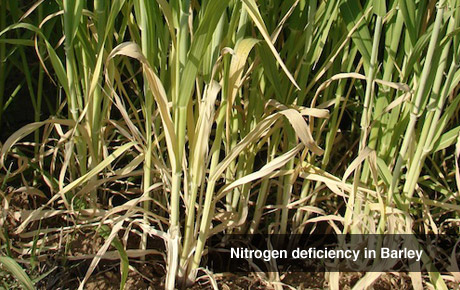
Adequate nitrogen produces a dark green color in the leaves, caused by the high concentration of chlorophyll. Nitrogen deficiency results in chlorosis (a yellowing) of the leaves because of the declining chlorophyll. This yellowing starts first on oldest leaves, then develops on younger ones as the deficiency becomes more severe. Slow growth and stunted plants are also indicators of nitrogen deficiency. Small grains and other grass-type plants tiller less when nitrogen is in short supply.

Phosphorous

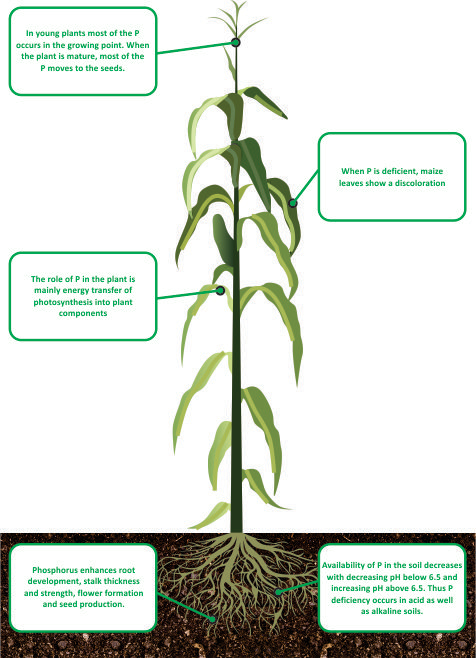
Phosphorus is a vital component of adenosine triphosphate (ATP), the “energy unit” of plants. ATP forms during photosynthesis, has P in its structure, and processes from the beginning of seedling growth through to the formation of grain and maturity.
The general health and vigor of all plants requires P. Some specific growth factors associated with P include stimulated root development, increased stalk and stem strength, improved flower formation and seed production, more uniform and earlier crop maturity, increased nitrogen- fixing capacity of legumes, improvements in crop quality, and increased resistance to plant diseases.
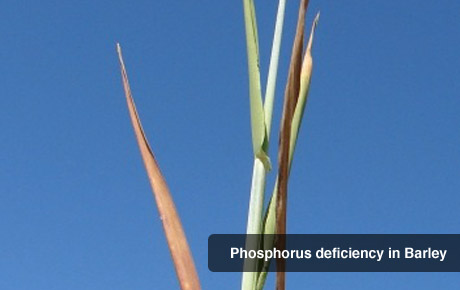
Phosphorus deficiency is more difficult to diagnose than a deficiency of N or potassium (K). Crops usually display no obvious symptoms of P deficiency other than a general stunting of the plant during early growth, and by the time a visual deficiency is recognized, it may be too late to correct in annual crops.
Some crops, such as corn, tend to show an abnormal discoloration when P is deficient. The plants are usually dark bluish-green in color, with leaves and stem becoming purplish. The genetic makeup of the plant influences the degree of purple, and some hybrids show much greater discoloration than others. The purplish color results from the accumulation of sugars, which favors the synthesis of anthocyanin (a purplish pigment,) which occurs in the leaves of the plant.
Phosphorus is highly mobile in plants and, when deficient, may translocate from old plant tissue to young, actively growing areas. Consequently, early vegetative responses to P are often observed. As a plant matures, P translocates into the fruiting areas of the plant, where the formation of seeds and fruit requires high energy. Phosphorus deficiencies late in the growing season affect both seed development and normal crop maturity. The percentage of the total amount of each nutrient taken up is higher for P late in the growing season than for either N or K.

Potassium

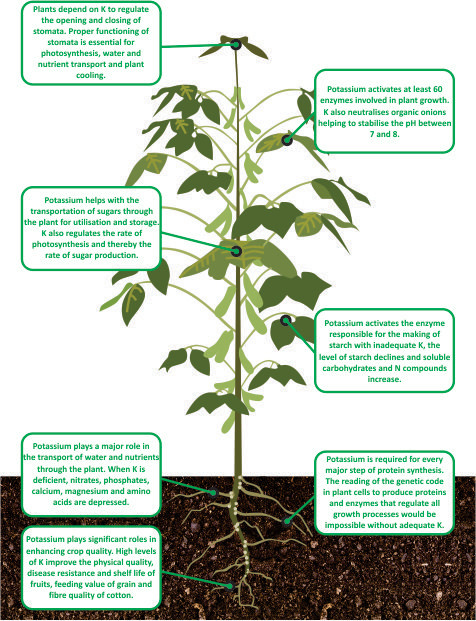
While potassium doesn’t constitute any plant structures or compounds, it plays a part in many important regulatory roles in the plant. It’s essential in nearly all processes needed to sustain plant growth and reproduction, including:
- photosynthesis
- translocation of photosynthates
- plant respiration
- protein synthesis
- control of ionic balance
- breakdown of carbohydrates, which provides energy for plant growth
- regulation of plant stomata and water use
- activation of plant enzymes
- disease resistance and recovery
- turgor
- stress tolerance, including extreme weather conditions
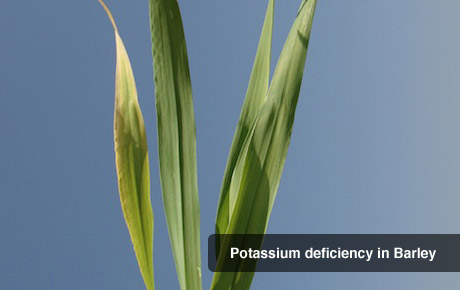
Perhaps potassium’s most important function in the plant is that it can activate at least 80 enzymes that regulate the rates of major plant growth reactions. Potassium also influences water-use efficiency. The process of opening and closing of plant leaf pores, called stomates, is regulated by potassium concentration in the guard cells, which surround the stomates. When stomates open, large quantities of potassium move from the surrounding cells into the guard cells. As potassium moves out of the guard cells into surrounding cells, stomates close, therefore potassium plays a key role in the process plants use to conserve water Potassium plays a key part in increasing yields and controlling disease because it improves a crop’s winter hardiness. It enables crops to get a quicker start in the spring and increases vigor so growth can continue throughout the growing season. Plants deficient in potassium don’t grow as robustly and are less resistant to drought, as well as high and low temperatures. They’re also more vulnerable to pests, diseases and nematode attacks. Potassium is also known as the “quality nutrient” because of its important effects on factors such as size, shape, color, taste, shelf life, fiber quality and other qualitative measurements.

Magnesium

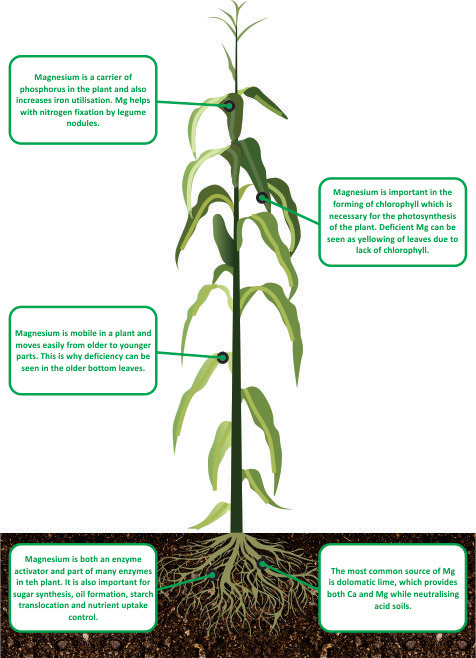
Magnesium nutrition of plants is frequently overlooked and shortages will adversely impact plant growth. Many essential plant functions require adequate Mg supplies, the most visible being magnesium’s role in root formation, chlorophyll and photosynthesis. Mg is required for crops to capture the sun’s energy for growth and reproduction. All crops require magnesium to capture the sun’s energy for growth and production through photosynthesis. Chlorophyll, the green pigment in plants, is the substance through which photosynthesis occurs. Without chlorophyll, plants couldn’t manufacture food.
Magnesium is an essential component of chlorophyll, with each molecule containing 6.7 percent Mg. Magnesium also acts as a phosphorus (P) carrier in plants, which is necessary for cell di¬vision and protein formation. So, Mg is essential for phosphate metabolism, plant respiration and the activation of several enzyme systems.
Soils usually contain less Mg than calcium because Mg is not absorbed as tightly by clay and organic matter and is subject to leaching. The supply of available Mg has been and continues to be depleted in some soils, but growers are noticing good responses to fertilization with Mg.
Magnesium’s availability to plants often depends on soil pH. Research has shown that Mg availability to the plant decreases at low pH values. In acidic soils with a pH below about 5.8, excessive hydrogen and aluminum can decrease Mg availability and plant uptake. At high pH values (above 7.4), excessive calcium may greatly increase Mg uptake by plants.
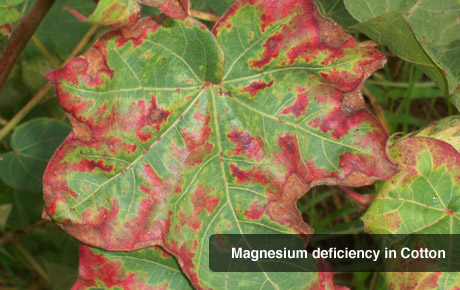
Magnesium is mobile within the plant and easily translocates from older to younger tissues. When deficiencies occur, the older leaves become damaged first, which may include color loss between the leaf veins, beginning at the leaf margins or tips and progressing inward, giving the leaves a striped appearance.